Project Concept
Zenith was born from a desire to transform a standard diagnostic tool into a warm, immersive experience that bridges the gap between technology and emotional intelligence. Built entirely in Python using the Pygame and Pygame_gui frameworks, the application functions as a real-time stress-management companion. Unlike static forms, Zenith utilizes a state-machine logic to guide users through a personalized dialogue tree, ensuring that the advice provided is contextually relevant to the user’s specific emotional state.
A primary goal of this project was to demystify mental health resources. By integrating evidence-based strategies directly into the character's dialogue, Zenith serves as a gateway to further education, inspiring users to explore the professional frameworks that inform the assistant's guidance.
Play Version 2.1:HERE
Zenith: Bridging Clinical Theory and Interactive UX
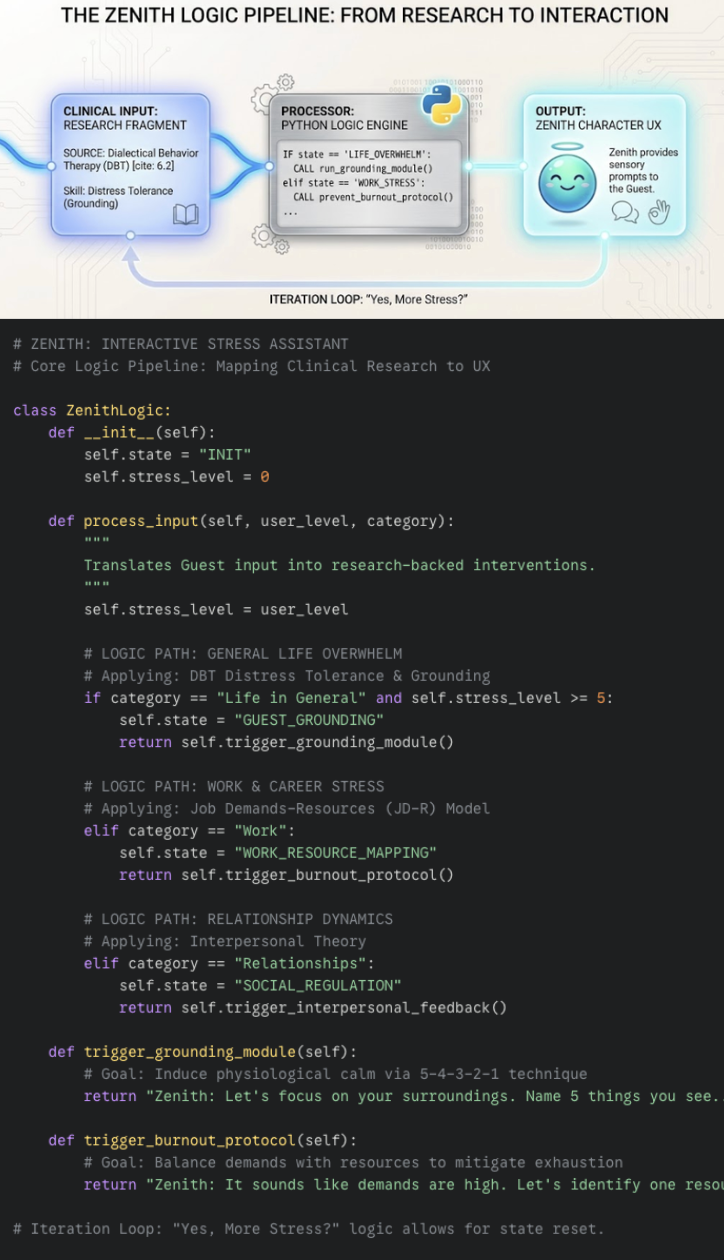
This visualization demonstrates the end-to-end logic pipeline I engineered for the Zenith Stress Assistant. By acting as the bridge between technical execution and psychological research, I ensured that every guest interaction is grounded in evidence-based methodologies.
The Pipeline Architecture:
Clinical Input: The system ingests fragments of established research, such as Dialectical Behavior Therapy (DBT) and the Job Demands-Resources Model, to define the assistant's knowledge base.
Python Logic Engine: I developed a custom state-machine in Python that maps specific user distress levels and categories to the corresponding clinical model. This ensures the program executes the correct intervention—like a Distress Tolerance (Grounding) module for acute overwhelm—rather than a generic response.
Character UX: The final output is rendered through Zenith, an ethereal 3D avatar designed to provide a calming, non-judgmental presence while delivering the research-backed sensory prompts to the guest.
Iterative Loop: The system maintains a feedback loop, allowing users to address multiple stressors in a single session, mimicking the flow of a supportive, real-time conversation.
Knowledge Base:
Distress Tolerance & Crisis: Linehan, M. M. (2014). DBT skills training manual. Guilford Publications.
Initial Stress Appraisal: Lazarus, R. S., & Folkman, S. (1984). Stress, appraisal, and coping. Springer Publishing Company.
Workload & Career Module: Bakker, A. B., & Demerouti, E. (2007). The job demands-resources model: State of the art. Journal of Managerial Psychology.
Relationship & Social Dynamics: Sullivan, H. S. (1953). The interpersonal theory of psychiatry. Norton.
"Life in General" Grounding: Beck, J. S. (2011). Cognitive behavior therapy: Basics and beyond. Guilford Press.
Loneliness & Support Path: Cohen, S., & Wills, T. A. (1985). Stress, social support, and the buffering hypothesis. Psychological Bulletin.
Behavioral Activation: Martell, C. R., et al. (2001). Behavioral activation for depression. Guilford Press.
Technical Mechanics
The core of the project is a robust State-Machine Architecture. Each "state" (from GET_NAME to SHOW_ADVICE) dictates what the user sees and how the program processes their input.
Dynamic Content Mapping: I engineered a complex dictionary system that maps user stress levels (0–7) to specific greeting tones and advice categories. This ensures that a user at a "Level 2" receives gentle encouragement, while a "Level 7" is met with immediate grounding techniques and crisis resources.
Responsive Logic Loops: The "Yes/No" loop mechanics allow for an iterative experience. If a user has more on their mind, the program resets its internal state to GET_STRESSOR_CATEGORY_AGAIN, skipping redundant introductory steps to maintain a natural conversational flow.
Visual Pipeline & Character Integration:
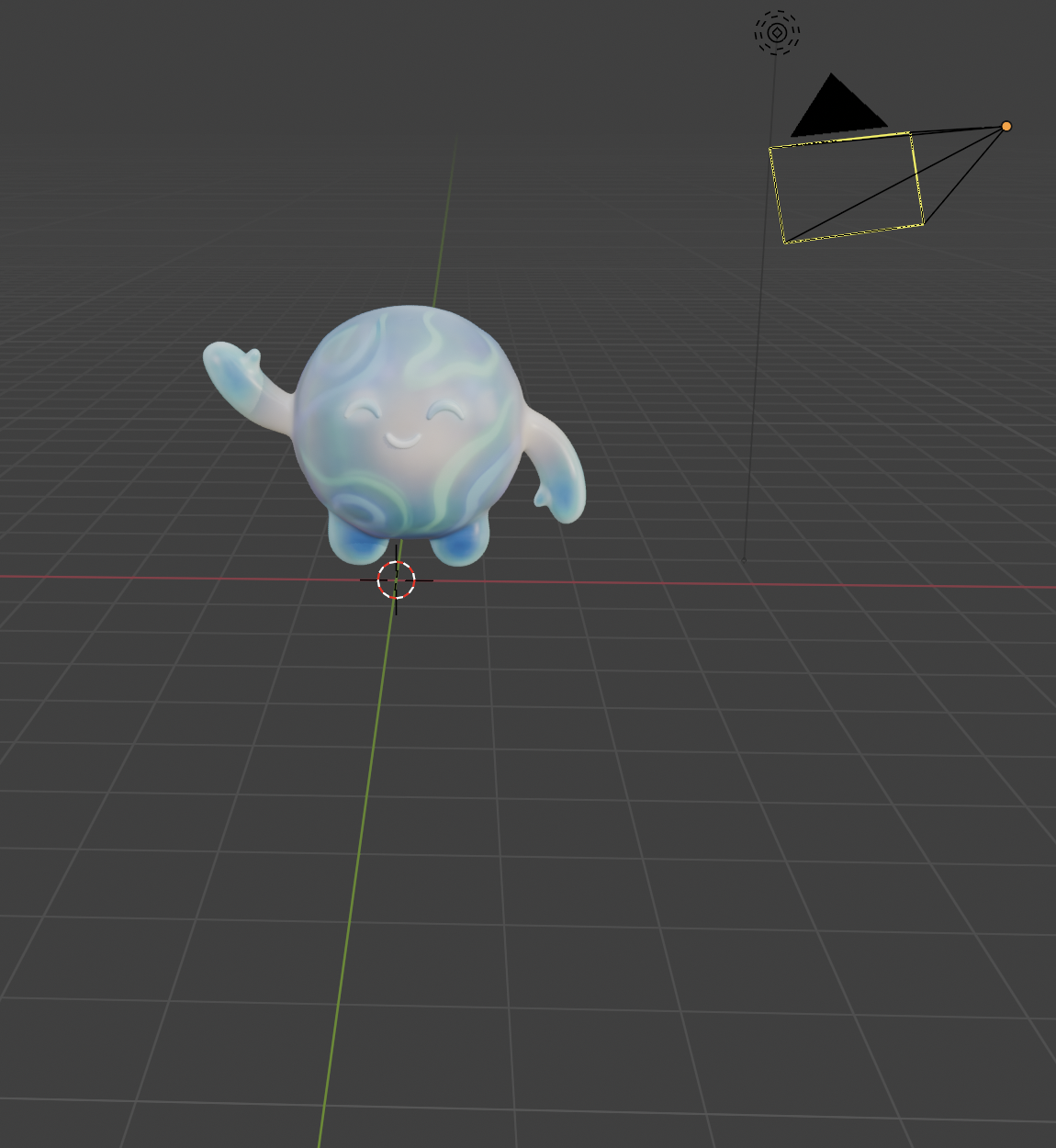
To ensure the user felt a genuine connection with the assistant, the visual development of Zenith was as rigorous as the backend logic. I developed a unified pipeline that prioritized emotional resonance and atmospheric immersion.
High-Fidelity Character Design: Zenith was modeled and rigged in Blender, allowing for fluid, expressive movements that respond to the user's input.
Procedural VFX Simulation: I utilized Houdini to simulate Zenith’s "halo" of stardust and internal energy patterns. These visual elements aren't just decorative; they are designed to pulse and shift in color based on the program's state, providing a non-verbal layer of empathy.
Atmospheric Compositing: Using After Effects, I composited the final avatar into a soft, ethereal environment with custom bokeh and lighting. This ensured that even during high-stress interactions, the UI remained a "safe space" for the user.
Interactive Experience Design:
Beyond the code and the art, the core of this project is Guest Experience (GX). I approached the design from the perspective of an immersive attraction:
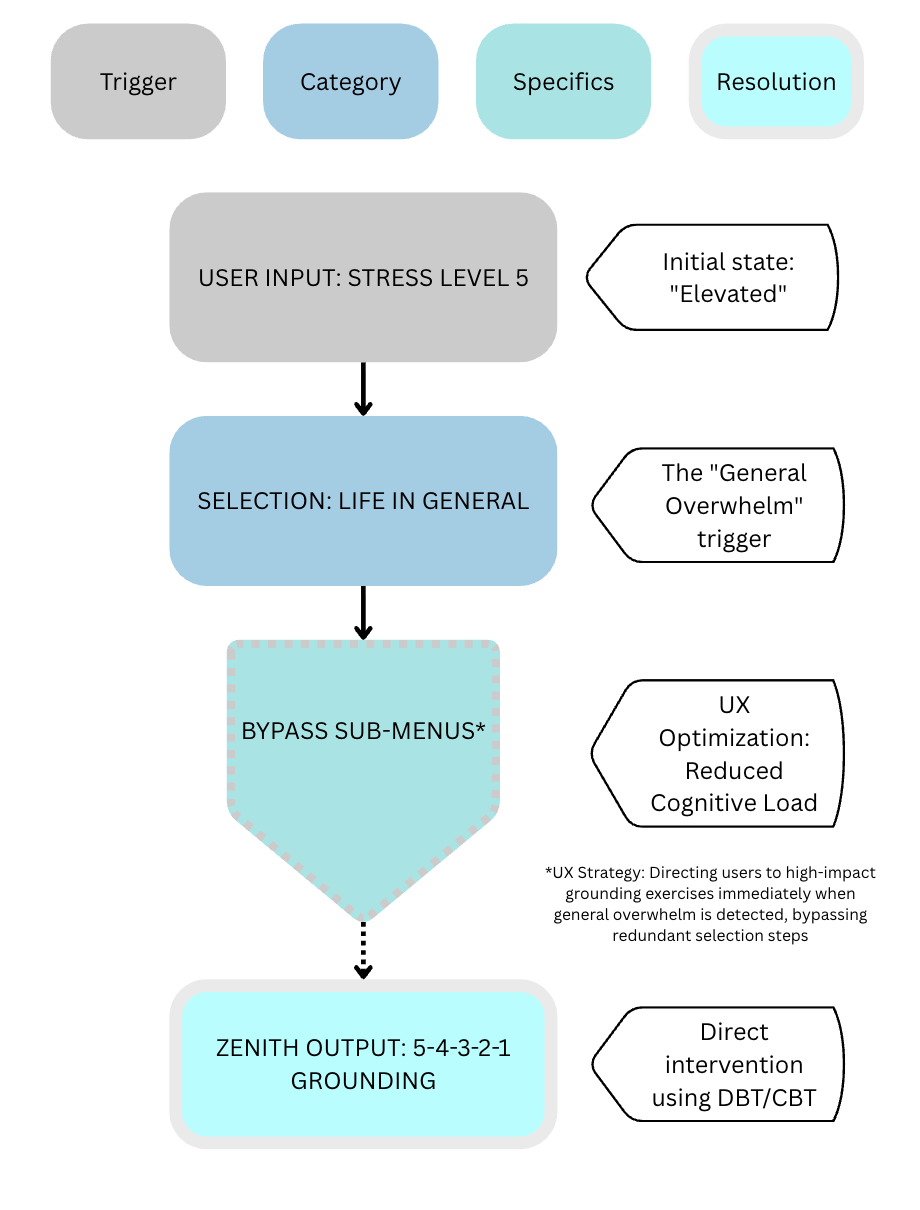
The "Short-Circuit" Logic: For users selecting "Life in General," I programmed the system to bypass sub-menus and jump straight to grounding exercises. This reduces "choice paralysis"—a critical design choice for users already in a state of high stress.
Research-Backed Dialogue: Every piece of advice is mapped to clinical frameworks, including DBT Distress Tolerance and CBT Grounding. By citing these sources, the project acts as an educational gateway, encouraging further exploration of mental health resources.
Zenith is a scalable blueprint for Spatial Computing and AI-driven Guest Empathy, demonstrating how to build "smart" characters for VR/AR environments, theme park attractions, educational materials, and more that don't just respond, but understand. This framework also offers a sophisticated solution for modern museum exhibits, where Zenith functions as an "Empathetic Docent". By applying the same adaptive state-machine logic used to manage user stress, the system can translate complex historical or scientific data into accessible, character-led narratives that adjust in real-time to a visitor’s level of engagement, curiosity, or fatigue. This ensures that high-level educational content remains emotionally resonant and tailored to the unique journey of every guest.